
Insights · AI & Multilingual Communication
How AI is reshaping translation, and how it can be used responsibly in Arabic-English work
AI can make multilingual work quicker and more accessible. But as the output becomes smoother and more convincing, it also becomes easier to miss where the meaning has shifted or where the wording no longer serves the purpose of the text.
By Abdulrahman Mohamed · 14 min read
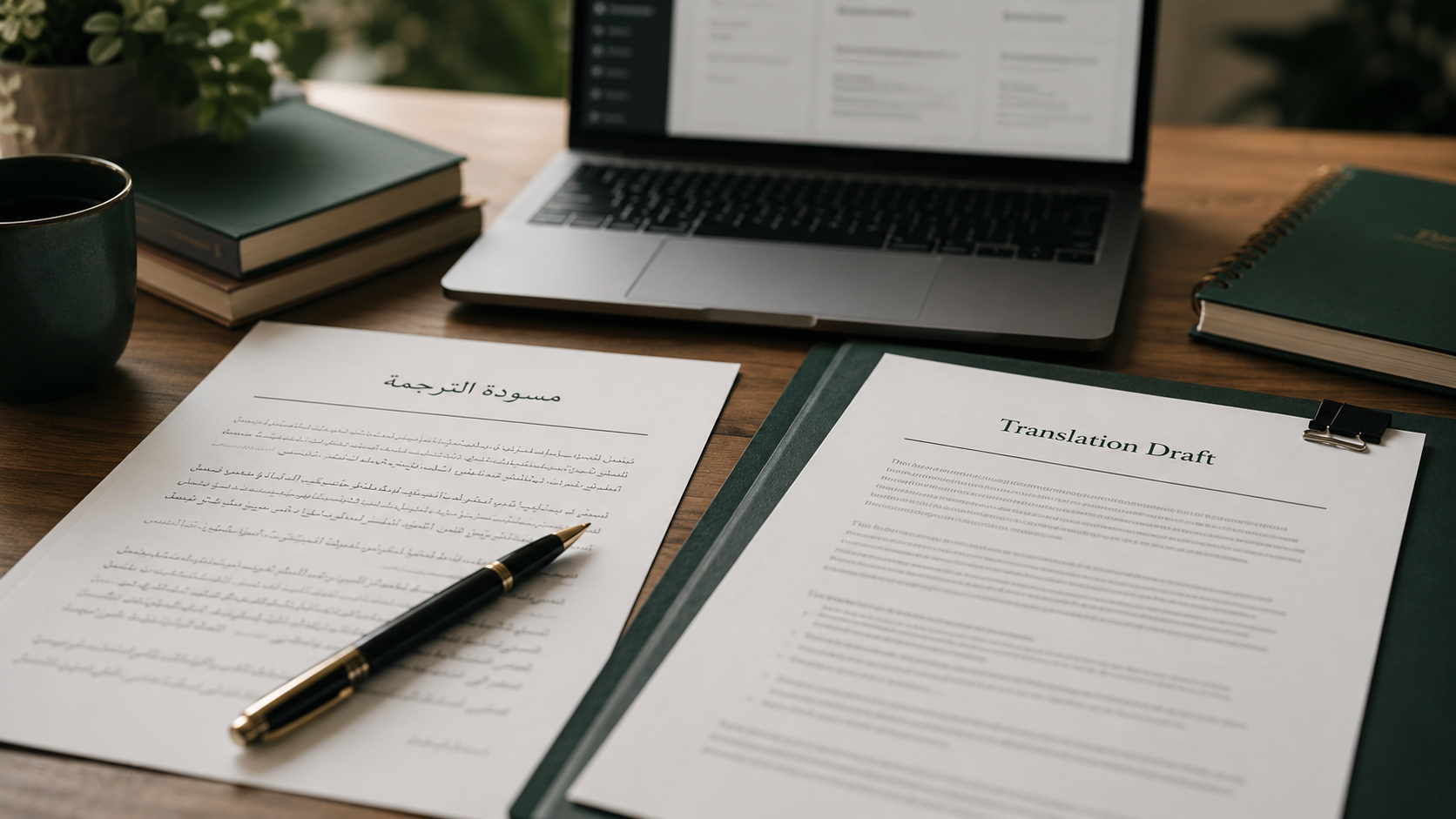
AI has become part of ordinary translation work far more quickly than many expected.
Not long ago, the discussion was usually quite limited. A team might ask whether machine translation could help them understand a document before deciding whether to commission a full translation, or whether it could reduce the time spent on repeated sections of routine material. The underlying assumption was still that machine output would be visibly rough and that a person would obviously need to intervene before anything important was used.
That assumption is no longer safe.
Generative AI can now produce a convincing first draft, compare versions of a document, propose terminology, summarise background material, and adapt the wording to suit a different audience or level of formality. It can do so across many language pairs, including Arabic and English, at a speed that makes it tempting to treat the result as more dependable than it really is.
There is real value in that capability. When AI is used in the right setting, it can remove some of the repetitive work that slows multilingual projects down. It can help a linguist prepare more efficiently, and it can give internal teams a quicker sense of what a document contains. For certain types of material and limited uses, it can also produce a strong first draft that gives the translator a useful starting point.
The difficulty is that the output can now look finished before it has actually been assessed.
A passage may be fluent enough to reassure a reader who does not know the source language, while still changing the force of a statement, overlooking an important limitation, or using terminology that does not fit the field. Where the source allows more than one reading, AI may commit to one without signalling that another is possible, even though a careful translator might preserve the ambiguity in the target text or seek clarification before resolving it.
The connotations created by the wording also matter. A choice that appears accurate at sentence level may make the target text sound more certain or more confrontational than the source intended, or turn a clear source into something unnecessarily vague. In sensitive material, the problem can be more serious because the output may add information that was not there or omit a qualification on which the practical meaning of the passage depends.
For organisations or individuals working between Arabic and English, or across other language pairs, the issue is therefore not whether AI belongs anywhere in the workflow. It often does. The more important task is deciding what role it should play, what information may safely be put into it, and when the final output needs a level of human review that goes well beyond a quick glance.
This article considers the practical uses of AI in translation, the circumstances in which its limitations become serious, and the safeguards that allow an organisation or individual to use it without mistaking speed for reliability. It also looks at the role Machine Translation Post-Editing (MTPE) can play within an AI-assisted translation workflow.
AI can shorten parts of the process. It cannot decide what a text means in context, what the reader needs to understand, or what may follow if the wording is misunderstood.
AI can assist human translation work without replacing it
The most sensible way to approach AI is as a tool that may support human translation work at particular stages, rather than as a substitute for the person responsible for the final meaning.
For low-risk material, it may produce a rough draft that helps an internal reader understand the broad subject of a document. In a large and repetitive project, it may help identify repeated wording or possible terminology. It can also be useful during preparation, for example by comparing versions of a text, drawing attention to inconsistent wording, or helping the translator identify passages that deserve closer scrutiny.
Those are meaningful uses. They can free up time that would otherwise be spent on mechanical repetition and leave more room for the work that requires judgement.
That work remains substantial. A translation still has to preserve what the source actually says, the degree of caution or certainty it expresses, the relationship between writer and reader, and the purpose the document is meant to serve. It also needs to use terminology that fits the subject and read naturally for the intended audience.
AI may help with some parts of that process. It cannot reliably settle all of those questions for itself.
The problem is no longer “obviously bad English”
Earlier forms of machine translation often made their limitations easy to notice. Sentences could be awkward, word order could feel unnatural, and grammar mistakes sometimes made it obvious that the result needed further work.
Modern AI has changed that.
Fluency is not proof of accuracy. A translation can sound polished and still misrepresent the text it was meant to carry.
Why Arabic-English work needs particular care
Arabic and English can communicate the same ideas with great clarity, but they do not always organise meaning in the same way.
Source texts may rely on contextual cues, the relationship between clauses, or established formal expressions whose force is not carried automatically into another language. The target language, whether English, Arabic, or any other language, may need a different structure to preserve the same effect. A literal or mechanically generated rendering can capture the broad topic of a passage while missing what the wording is actually doing.
This can still matter in ordinary professional correspondence, but the risks become greater in material such as public statements, policy documents, donor communication, legal or procedural notices, conference speeches, and sensitive internal correspondence.
It also matters in specialised writing. A theological, academic, legal, or technical passage may contain distinctions that are easy to blur if the translation is treated as a sequence of sentence-level substitutions. The English may remain grammatically sound while becoming less precise than the Arabic, or more obscure than it needs to be.
The real question is not whether every Arabic word can be matched with an English equivalent. It is whether the English reader is led to understand the same point with the same degree of qualification, seriousness, and practical force.
What responsible use requires in practice
A careful translator will sometimes need to stop and ask what the source is intended to mean.
AI often proceeds without doing that.
Where a phrase could reasonably bear more than one interpretation, a system may choose one and present it as settled. It may not indicate that another reading is possible or recognise that clarification is needed. In those cases, the answer is not always to force a choice. The ambiguity may need to be preserved in the target language, examined through the wider context and relevant sources to establish the intended or most likely meaning where possible, or the translator may need to ask for clarification before continuing.
The important point is that uncertainty should be recognised and handled deliberately rather than disappearing behind fluent wording. This is especially important in formal correspondence, policy material, procedures, contractual language, and any context in which a small shift in wording may have legal, financial, or reputational consequences.
Terminology also needs active control.
The same Arabic term may require a different English rendering in finance than it does in humanitarian work. A word that seems straightforward in public policy may have a specialised meaning in law, medicine, sport, education, or technical documentation.
AI can suggest familiar-looking equivalents quickly. It cannot simply be assumed to know which terms an organisation has already approved, how a sector uses a particular expression, or what the intended reader will understand from it.
Terminology is not just a matter of making a glossary. It is part of how an organisation keeps its communication consistent over time. Approved terminology, previous translations, subject-specific reference material, and guidance from the client or organisation should therefore form part of the workflow rather than being consulted only after a problem appears.
Tone requires the same attention.
AI can make text sound smoother, yet still alter the relationship between the writer and the reader.
A courteous Arabic request may become so softened that it no longer feels like a real request. A formal instruction may become unnecessarily blunt. A carefully measured public statement may sound more certain than intended. A sensitive message may lose the warmth, restraint, or seriousness that made it appropriate.
These are practical concerns. Tone affects trust, authority, and how people respond. Reviewing it properly means considering not only whether the wording sounds natural, but whether it places the reader in the same relationship with the writer that the source intended.
The more visible the final text will be, the deeper that review should go.
A published report, a donor appeal, a website page, a speech, or a statement to partners represents the organisation in its own right. It needs to read as considered English, not merely as output that is plausible enough to avoid an obvious error.
Confidentiality needs a real process
One of the first questions an organisation should ask is whether the material can be placed into an AI system at all.
It is not enough that a tool is popular or that its output appears useful. The organisation needs to understand what information is being uploaded, how it is processed, whether it may be retained, who may have access to it, and what protections apply.
This is especially important where documents contain personal data, legal advice, commercially sensitive material, health information, unpublished research, security-related content, or confidential negotiations.
A practical policy should separate material into categories.
Publicly available material, general background information, and non-sensitive drafts may be suitable for approved AI-assisted workflows. Internal documents that are not highly sensitive may require an approved tool and clear limits on what can be uploaded. Restricted material should not be entered into public AI systems without a specific and properly authorised basis for doing so.
The point is not that every organisation needs a large compliance operation before it can use AI. It is that someone needs to decide what is allowed, through which tools, and under what safeguards.
Human review is not one single service
It is also important to be clear about what “human review” means.
A quick check by someone who reads English well is not the same as a bilingual review of the translation. Nor is ordinary proofreading the same as Machine Translation Post-Editing, usually referred to as MTPE.
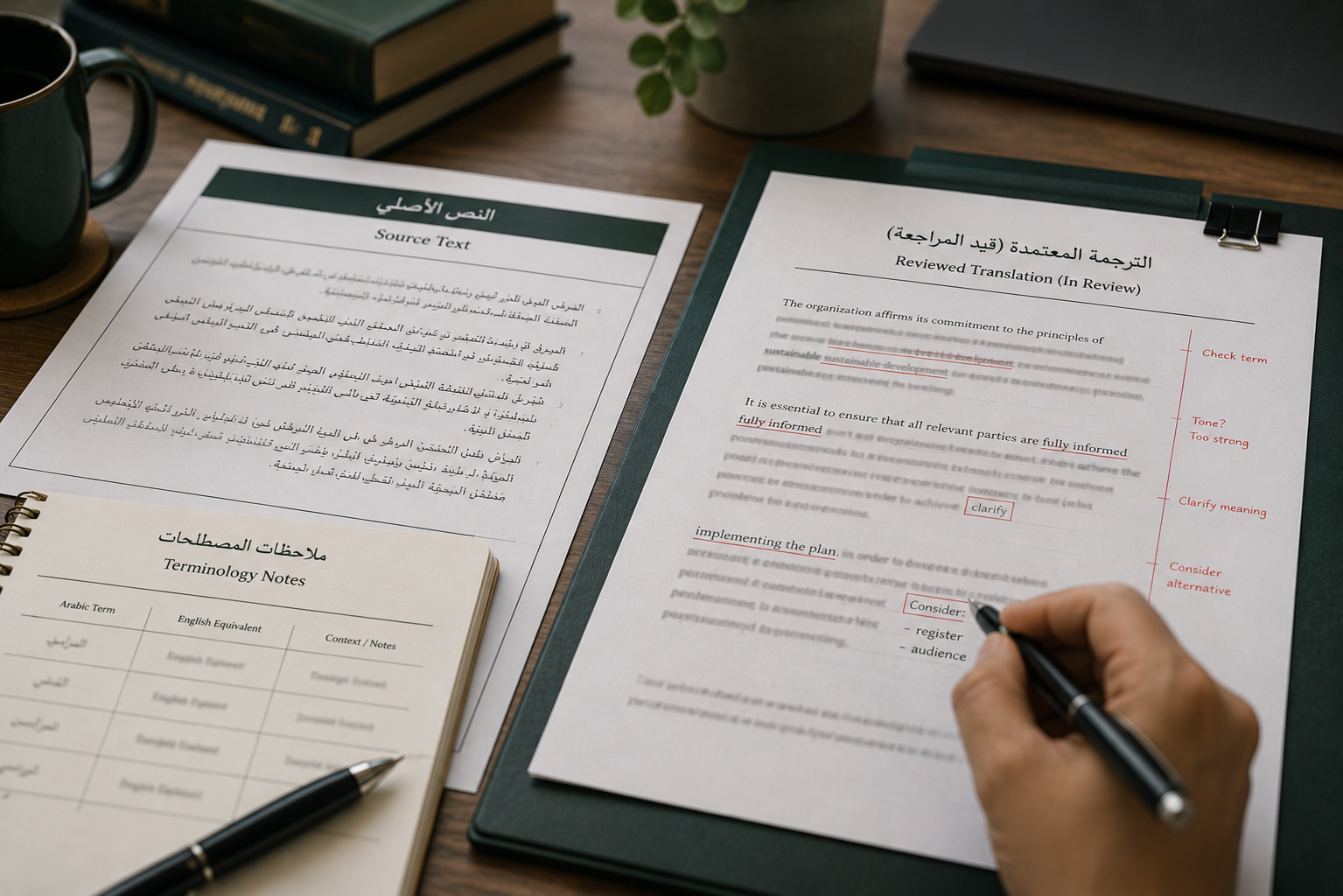
Light post-editing
Light post-editing may be suitable when machine output is already broadly usable and the purpose is limited to internal understanding or straightforward communication.
The reviewer may correct obvious mistranslations, grammar problems, missing content, terminology issues, and phrasing that is clearly awkward.
Machine Translation Post-Editing (MTPE)
Machine Translation Post-Editing, or MTPE, is used where machine or AI-generated output provides a workable starting point and the task is to improve it efficiently.
The depth of MTPE can vary. In a lighter form, the reviewer may focus on serious errors and obvious fluency problems. In a more thorough form, the reviewer works closely against the source and considers whether the English is suitable for its intended audience.
MTPE can be useful, but it should not be treated as a lower-cost substitute for every kind of translation work. It is a different workflow. Whether it is appropriate depends on the source material, the quality of the initial output, the intended use, and what is at stake if the final English is misunderstood.
Full bilingual revision and editorial work
Where material will be published, presented publicly, relied upon formally, or used to represent an organisation externally, the work often needs to go further.
The English should be checked carefully against the Arabic and then treated as a finished piece of writing in its own right. That may involve restructuring a sentence for clarity, refining the tone, ensuring terminology is consistent across a wider project, and making connections explicit where the target reader needs them.
A human glance at AI output is not the same as a professional review of the translation.
A practical framework before using AI
Before using AI in Arabic-English work, an organisation should pause and consider the purpose of the text.
Is the material being used for internal background understanding, public communication, a formal decision, a client relationship, a legal process, a speech, or publication? The more significant the purpose, the higher the level of review that should follow.
It also matters who will rely on the English. A reader using it for general background is in a different position from someone who will make a decision, follow an instruction, assess an organisation, or pass the material on to others.
The sensitivity of the material should be considered before anyone assesses the translation quality. If the content includes confidential, personal, legal, financial, or security-related information, the tool itself must be appropriate for that use.
Finally, the organisation should decide in advance what level of review will follow. Will the output receive light post-editing, MTPE, bilingual revision, or full editorial work? Leaving that question until after the text has already circulated is usually too late.
Standards that make AI-assisted work more dependable
A responsible AI-assisted translation workflow does not need to become bureaucratic. It does, however, need to be clear.
Approved tools should be identified for different types of material. Confidentiality rules should explain what must never be uploaded, what may be used only through approved systems, and who can authorise an exception.
The source text also needs attention. AI cannot resolve a vague, incomplete, or poorly drafted Arabic source. Where the meaning is unclear, the issue should be resolved before translation rather than hidden behind fluent English.
Terminology needs to be controlled through approved names, previous translations, style guidance, and project-specific reference material. Human review should match the level of risk. Finally, there should be a clear record of what tool was used, what level of review followed, and who approved the final text.
These are not formalities for their own sake. They are the practical conditions that prevent speed from becoming a substitute for accountability.
AI makes human judgement more valuable
AI may reduce time spent on routine repetition. It does not reduce the importance of the work that requires real linguistic judgement.
Someone still needs to identify what the source actually means, recognise when an ambiguity should be raised rather than silently resolved, protect terminology, understand the target audience, preserve tone, and decide whether the final English is safe to use.
That is where the role of the linguist becomes clearer, not smaller.
Translation work has practical consequences
AI has made it easier than ever to produce a translation that reads smoothly and appears ready to use.
That can be useful. It can also create confidence that has not yet been earned.
For low-risk material, a carefully controlled AI-assisted workflow may save time and help people access information more quickly. For public, sensitive, technical, or high-stakes communication, the question is whether the organisation can stand behind the English once it has been read, acted upon, shared, or relied upon.
Use AI where it genuinely improves efficiency. Keep human judgement at the centre whenever meaning, trust, confidentiality, or practical consequence is at stake.
Need Arabic-English work reviewed, post-edited, or prepared for external use?
Request a quote